
How Imperial Beach Resident Searches Begin
A useful Imperial Beach residents directory search follows the record that was created by the event. A property question begins with an address or APN, the San Diego parcel identifier. A family-history question may begin with a directory, census schedule, obituary, or vital record. A court question belongs in the San Diego Superior Court index. The right first source reduces false matches because each custodian records a different relationship to a person or place.
Begin with a name, address, or date range. Keep the exact spelling and every variant. Then compare two independent details, such as an address and middle name, before treating a result as the same person. A roll owner is not automatically an occupant, and a directory listing is only a snapshot from its publication year.
- Normalize the street address and confirm the delivery ZIP with USPS.
- Use the San Diego assessor or GIS tools to locate the parcel and note the APN.
- Search the ARCC recorded-document index by grantor or grantee name, then use a kiosk or copy request when the image or APN route is needed.
- Match the time period with a directory, census schedule, newspaper, court, or vital-record source.
- Ask the city or county records office for an identifiable record when no public portal holds the needed item.
That sequence keeps the Imperial Beach residents directory grounded in custodial records. It also leaves room for a lawful family-history or reconnection search when the public roll does not answer a private-contact question.
Offices Behind Imperial Beach Resident Records
Imperial Beach is an incorporated city, but most records that can connect a person to land or an event are kept outside City Hall. The City Clerk is the local gateway for agendas, ordinances, contracts, planning material, permits, correspondence, and other city-held records. San Diego County ARCC combines assessor, recorder, and county-clerk functions. The Superior Court holds cases, while California agencies hold statewide licenses, businesses, voter administration, and vital-record products.
The following offices are useful starting points, but each answers a different question. The ARCC Recorder line is 619-238-8158 for recorded-document help. The Assessor phone is 619-236-3771 for ownership and address information suppressed from the web roll. San Diego County Registrar of Voters assistance is 858-565-5800. A city request should identify the department, subject, address or project number, and date range.
San Diego County ARCC Recorder
Official Records Search and copy service
San Diego County, CA
619-238-8158
San Diego County Assessor
Parcel, roll, mailing, and situs information
San Diego County, CA
619-236-3771
Registrar of Voters
Voter status and qualified-use election records
San Diego County, CA
858-565-5800
City-held requests follow the California Public Records Act, Government Code Sections 7920.000-7931.000. The law requires an identifiable existing record, not a new list made from several systems. County requests go through the San Diego County Public Records Request Center when the record is not already exposed by a portal.
The APN Bridge Across Imperial Beach Records
An APN is the strongest bridge among the assessor, GIS, deed, and survey systems because names and street text change. The San Diego secured roll accepts a parcel number or an address, but public web ownership is suppressed. The Imperial Beach MapGeo viewer can locate a parcel and show geometry after its disclaimer, yet anonymous access blocks owner, APN, assessed-value, abutter, and export fields. SanGIS and county parcel maps add boundary and adjoining-parcel context.
Use the APN to compare the situs address, the assessor mailing address, the legal description, and the recorded deed. Those fields can point to the same land while answering different questions. The situs is the physical parcel. The mailing address routes tax notices. The legal description identifies the land in a deed. None alone proves who sleeps there.
An overview of San Diego County ARCC services is useful before switching between assessor and recorder tools. For an address history, keep a small research note with the APN, search date, source, and exact spelling used.
The APN connection matters most when a street name is old, a unit has its own parcel, or a subdivision map uses lot and block language instead of a modern street number.
The ARCC Official Records portal exposes a name-based index, while its parcel-number route remains a kiosk option. These are the main fields to expect:
| Field | Type | Access note |
|---|---|---|
| Grantor / Grantee mode | Search mode | Uses indexed party names and variants |
| Party name | Text | Core web criterion for the online index |
| Document number | Index or result key | Can identify a copy request |
| APN | Kiosk search only | Removed from online search December 9, 2024 under AB 1785 |
| Recording year or date | Result key | Recording date may differ from execution or transfer date |
One record image in the manifest comes from the San Diego County Assessor/Recorder/County Clerk entry point. It represents the county office layer behind an Imperial Beach residents directory search. The current roll, deed index, and map view should still be checked separately.
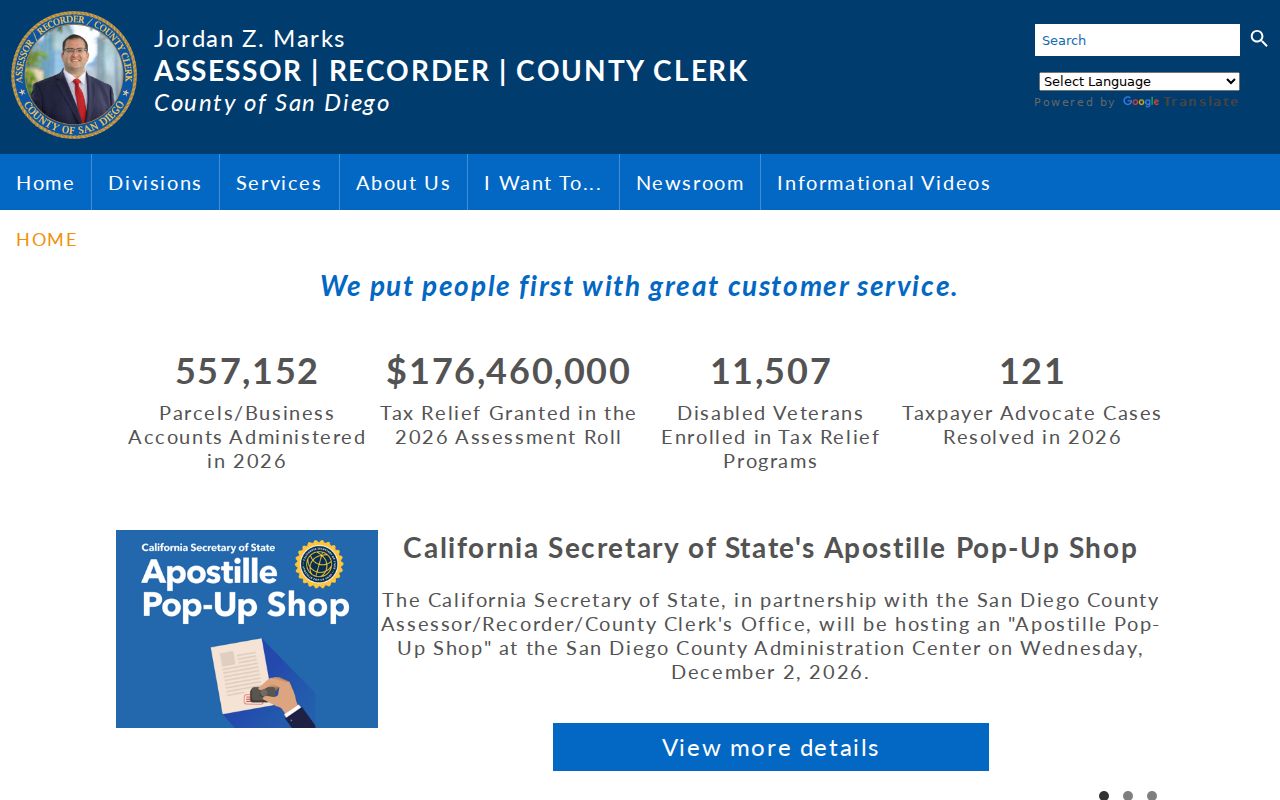
The county screenshot is a signpost, not a substitute for a parcel result or certified document. A result must be verified with the office that created it.
- Parcel
- A mapped piece of land identified by the county APN.
- Index
- A finding aid with names or keys, not necessarily the full record image.
- Roll
- A periodic assessment record that describes taxable property and related fields.
- Criss-cross directory
- A reverse address section that may show an apparent occupant for a publication year.
Owner Names Are Not Imperial Beach Occupants
A deed or assessor entry identifies title or roll ownership, not every person living at an Imperial Beach address. The owner may use a different mailing address, hold the parcel through an entity, occupy it only part of the year, or have no day-to-day connection with the site. Renters, household members, utility customers, minors, and DMV customers are not safely inferred from the property roll.
This distinction is the central myth to avoid in a residents directory. A matching name is a lead. It becomes stronger only when an independent record from the same time period supplies a second detail, such as a middle name, court location, business role, newspaper event, or historical address. A current assessor field can guide the next search without becoming a claim about residency.
Use with care. Imperial Beach records are for personal, lawful research. Do not turn an address lead into repeated unwanted contact, surveillance, threats, or harassment.
For street-level parcel work, use the Imperial Beach street directory workflow. It keeps the present address chain separate from the historical and one-person searches.
Current Imperial Beach Resident Sources
Current records behave like partial directories. They list people connected to a role, event, parcel, or public function, not one complete household roster. The table shows the question each source can answer and the limit that should travel with the result.
| Source | Connection shown | Keeper | Access and limit |
|---|---|---|---|
| Assessor roll | Parcel and roll owner context | San Diego ARCC | Address/APN route; web owner data suppressed |
| Recorded-document index | Grantors, grantees, liens, transfers | ARCC Recorder | Free indexed search; image/copy route differs |
| Voter status | One authenticated voter’s status | California SOS / San Diego ROV | Exact self-lookup, not a public neighbor list |
| City staff directory | Official name, title, and contact | Imperial Beach | Official capacity only |
| License or business search | Public commercial role | California boards / SOS | Role or entity evidence, not home residence |
Custody searches are narrower still. The Sheriff Who’s In Jail tool covers current county custody, CDCR covers state-prison custody, and Megan’s Law displays only its statutory public subset. A current result needs identity checks and should not be treated as a complete life history.
The next image points to the San Diego County Sheriff custody search, which is one defined public record rather than a general Imperial Beach resident directory.
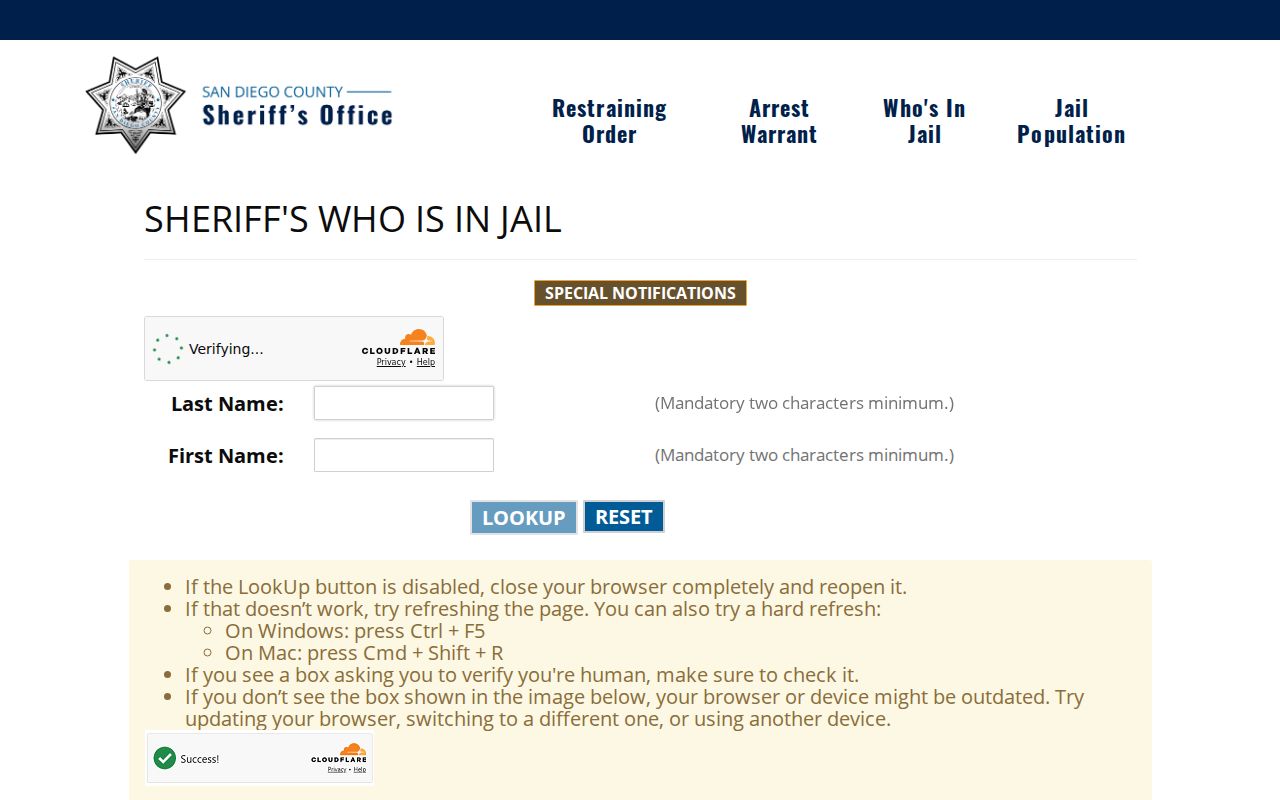
Its scope is current custody. Court, release, and identity questions require the separate custodian and record type.
Imperial Beach Official Rolls Versus Compiled Results
Official records and commercial people-search compilations serve different purposes. A county, city, court, library, or state custodian created an official record for a defined event or function. A compiled result may merge public and nonpublic inputs, carry stale addresses, or join two people with similar names. The category comparison belongs in the searcher's judgment before any result is shared.
| Route | What it is good for | What still needs checking |
|---|---|---|
| Official county or city record | Property, deed, permit, civic, or administrative event | Custodian date, redactions, and the record's defined scope |
| Official court or vital record | Case or life event tied to a named role | Identity match, eligibility, image access, and copy type |
| Historical directory or census | Dated household, address, or family-history snapshot | Edition coverage, boundary, publication gap, and date |
| Commercial compiled result | A lead for a lawful personal search | Source freshness, merged names, opt-out status, and custodian proof |
For reconnecting, an organization that forwards a message or a library source that confirms a past address is often safer than publishing a private contact detail. The result should remain as narrow as the evidence.
Imperial Beach Voter Lookup Is Self-Service
California My Voter Status authenticates the person entering the form. Its fields include first name, last name, date of birth, and either a California driver license or ID route or the last four digits of a Social Security number, with an option to indicate that an identification field is unavailable. A match can return registration status, address, party preference, language preference, vote-by-mail or provisional status, polling place, and election details.
That is useful for checking one’s own record. It is not a public way to ask who is registered at a block or address. Elections Code Sections 2188-2194 govern qualified uses of voter files and exclude sensitive identifiers such as signatures and full identification numbers. Aggregate reports can support precinct or city context without making a resident roster.
The exact California My Voter Status form is the right route for a self-check. The San Diego lookup and its 858-565-5800 phone line are a separate county assistance channel.
San Diego Court Records in an Imperial Beach Search
Imperial Beach has no municipal court. Civil, criminal, family, mental-health, and probate matters are searched through the Superior Court of California, County of San Diego. The party-name route accepts case type, case location, party type where relevant, beginning and ending filed years, last or business name, first name, and date of birth, followed by submit, reset, and captcha controls. More name detail matters because common-name results are capped.
The court index excludes juvenile, traffic or minor-offense matters, sealed records, and pre-1974 cases. Some older cases may require courthouse microfilm, and court staff do not perform that research for the requester. The Register of Actions can show case details, parties, hearings, and filing events. Some civil, small-claims, and probate documents in cases begun on or after January 1, 2008 can be purchased; some imaged family documents begin with cases filed August 24, 2015. Criminal documents require courthouse or mail access.
The San Diego Superior Court case-search page explains the coverage boundary. Federal matters go to PACER and the Southern District of California, not the county index.
A court image from the manifest shows the official search channel. Use the linked Superior Court source before relying on a party result.
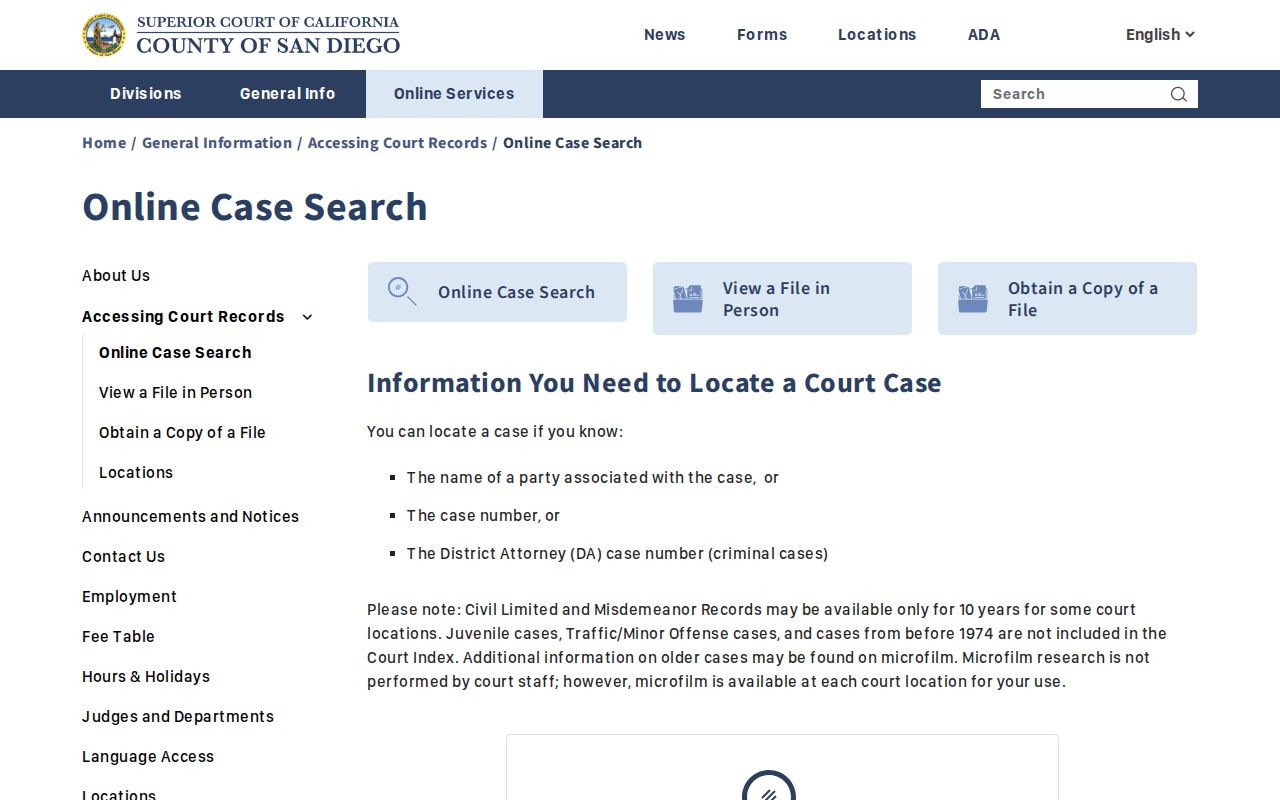
A party entry is an index lead, not a criminal-history certificate. Confirm the case number, filing date, location, and role before matching it to a person.
Imperial Beach Birth, Death, and Marriage Records
San Diego County ARCC issues local birth, death, and marriage certificates. California Department of Public Health Vital Records supplies statewide service and products for records outside local availability. Divorce is different: CDPH can issue a certificate of record for specified years, while the judgment and case file remain with Superior Court.
Informational copies of public birth, death, and marriage records are available to the public but are marked not valid for identity purposes. Authorized certified copies require an eligible relationship and a sworn statement under Health and Safety Code Sections 103526 and 103526.5. Confidential marriages have narrower access. Fees and processing estimates can change, so the current ARCC or CDPH form controls.
For the 2026 fee schedule in the research, county birth, death, and marriage products are $34, $26, and $19; the state birth, death, and marriage figures are $31, $26, and $19. Those amounts can change. A confidential marriage is narrower still, and a CDPH divorce certificate is not the Superior Court judgment.
The California vital-records office is the statewide fallback when a county copy is not the right product. A certificate connects a documented event to a person; it does not create a current residents directory.
Earlier Imperial Beach Resident Directories
Historical city directories answer a different question from a current roll. San Diego Public Library’s California Collection verifies a physical San Diego City Directory run from 1886 through 2021. The City Digital Archives lists selected digitized volumes from 1874 and 1926-1960, including suburban editions that are a plausible route for Imperial Beach. A local entry must be checked before a specific volume is said to cover the city.
Printed directory entries can pair a surname with a given name or initial, spouse notation, occupation, employer, residence or house marker, street address, and widow notation. A reverse or criss-cross section, where a volume has one, reads by address. The collection’s own abbreviation key controls marks such as `h`, `r`, `emp`, or `wid`. The San Diego City Digital Archives holds the scans; the full shelf treatment belongs in the city-directories page.
Before 1956, a person now described as an Imperial Beach resident may appear under South Bay, San Diego County, a subdivision, or another broader geography. Pair a directory year with a census schedule, newspaper notice, deed, or vital index. Absence in one directory year is not proof that a person was absent.
A separate official-search image in the manifest points to the California Department of Consumer Affairs license search.
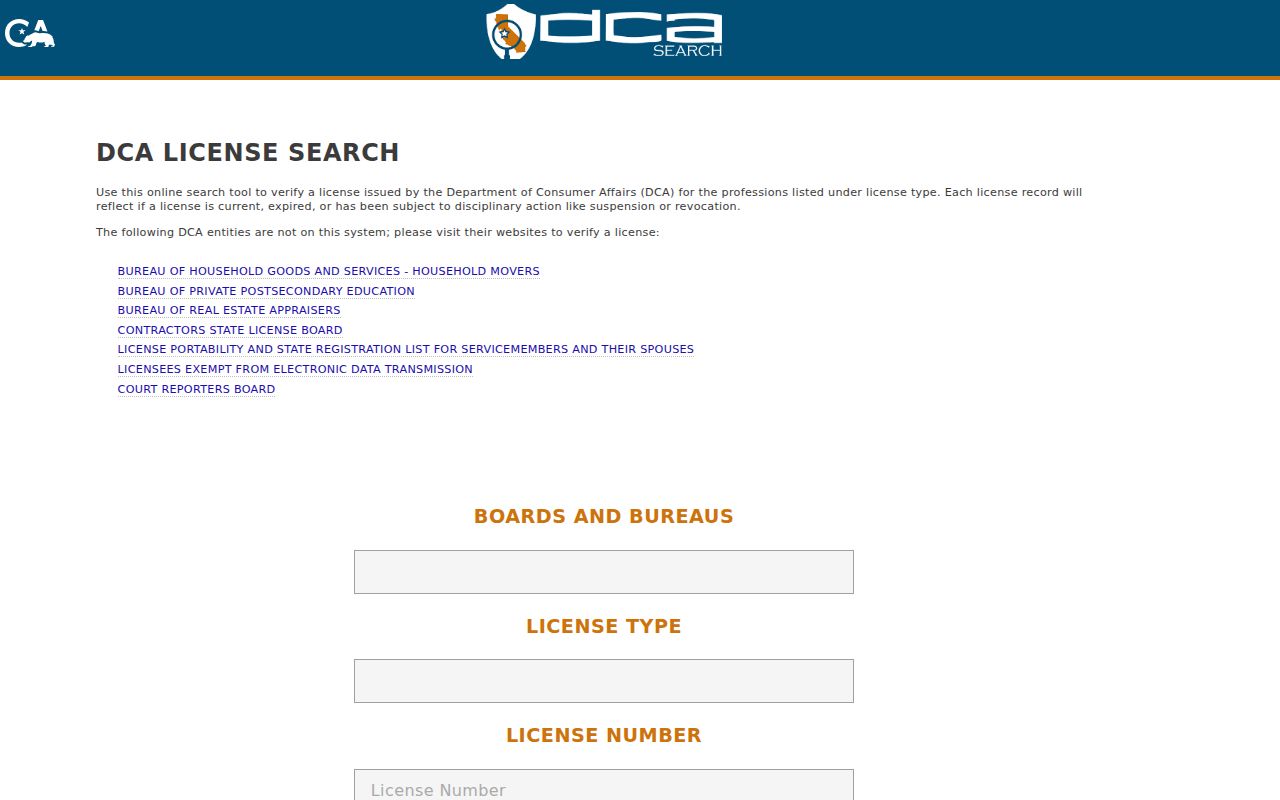
The image is a reminder that official search tools differ by record type. A directory shelf is historical evidence, while a license portal identifies a public professional role.
Imperial Beach Before Incorporation
San Diego County dates to California’s original county system in 1850, while Imperial Beach incorporated in 1956. County deeds, court files, board records, census schedules, and early directories therefore predate the city name by decades or more. A search that uses only the modern city label can miss the older record path.
The Clerk of the Board database reaches from 1877 to today and includes agenda indexes, minute orders, statements of proceedings, board letters, and support documents. Search by document type, keyword, date, property or condition, reel, and frame. Results cap at 400, so narrow the query. These records can surface old road names, subdivisions, petitions, and public infrastructure without pretending to be a private household roll.
For genealogy, test South Bay and San Diego County catalog terms, then use maps and enumeration districts to reconcile the old geography. The county archives also hold physical official-record series from 1848-1959, with a bulk of 1873-1931, when the online index is not enough.
Imperial Beach Business and License Clues
Public business and professional records can help verify a role, a trade name, or an event connected to a person. California Secretary of State bizfile searches entities by name or file number and can show entity number, status, formation, addresses, agents, officers or managers, and filing PDFs. San Diego County ARCC handles fictitious business names. The Department of Consumer Affairs search accepts board or bureau, license type, number, business name, first name, last name, and registry number, with more filters in advanced search.
These sources identify people acting in public commercial or professional roles. A business address is not proof of a home address, and a license record does not establish that a person lived in Imperial Beach. Open the issuing board detail because the broad result can omit discipline or conditions.
The California Secretary of State bizfile search image shows one official entity-checking channel.
For an entity trail, compare the public filing with the local FBN or city record rather than treating a commercial compilation as a final source.
Bizfile’s public search is available at California Secretary of State bizfile Online. It can support seller or estate research when the public role itself is the question.
Protected Addresses in Imperial Beach
California Safe at Home provides a substitute mailing address and confidential mail-forwarding route for eligible survivors and certain public-facing workers. A protected voter or substitute address is a boundary, not a puzzle. Do not try to reverse it through a deed, map, court file, or data-broker listing.
Recorded-document redactions can protect Social Security numbers, military discharges, and defined officials or victims. Voter files omit sensitive identifiers, and DMV address information is not a lawful public directory. California privacy rights and the state’s data-broker deletion program apply to covered businesses, not to a county custodian’s duty to retain a lawful public record.
California’s Megan’s Law registry also displays only a statutory public subset. The California DOJ registry includes its own use warning and should never be used to identify a person from a name or map point alone.
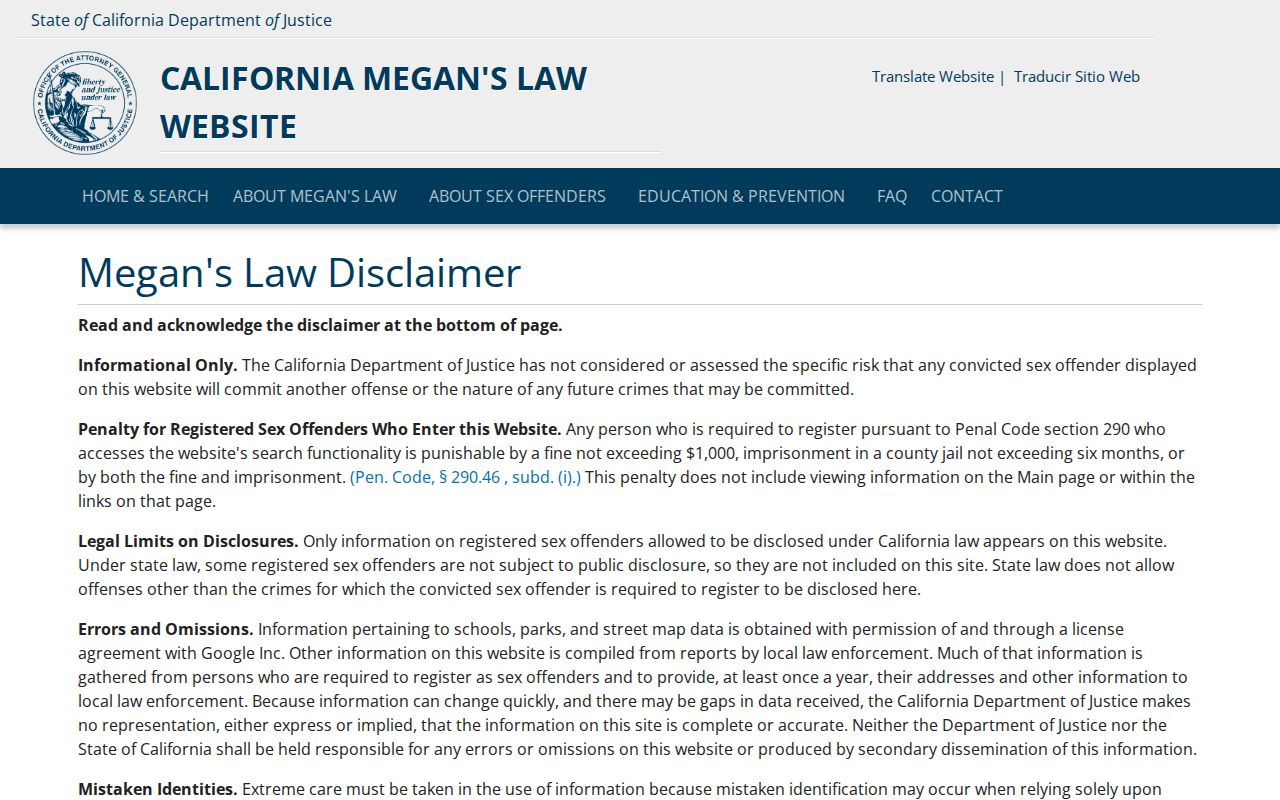
The image connects the legal boundary to a real official channel. A public display still has a limited purpose and must be read with the custodian’s warnings.
Verify Every Imperial Beach Directory Result
A residents directory result is a lead until the custodian confirms the record and two independent details agree. Check the source date, record type, spelling, location, and role. Separate ownership from occupancy, an index from an image, and a historical snapshot from a current status. For a family or heir search, combine death, probate, obituary, directory, and census evidence with restraint.
When an online portal fails, the fallback is part of the search: ARCC kiosk or mail copy, a city or county CPRA request, a library reading room, county archives, courthouse microfilm, or the office phone. San Diego County moved new public-record requests to the centralized searchable platform on March 21, 2024, so released requests may reveal a useful prior route before a duplicate filing.
The safest conclusion is narrow. State what the record says, name what it does not establish, and send corrections to the office that created it. That is how an Imperial Beach residents directory remains useful without becoming a claim about a private household.